Amoebatu
Open source · MIT · early and under construction

What if your office full of PCs was one computer?

Amoebatu is a distributed computing layer for Linux clusters. You write plain, Python-shaped code. The runtime finds the parallelism and sends each function wherever it runs best.

No shared storage No central scheduler No single point of failure
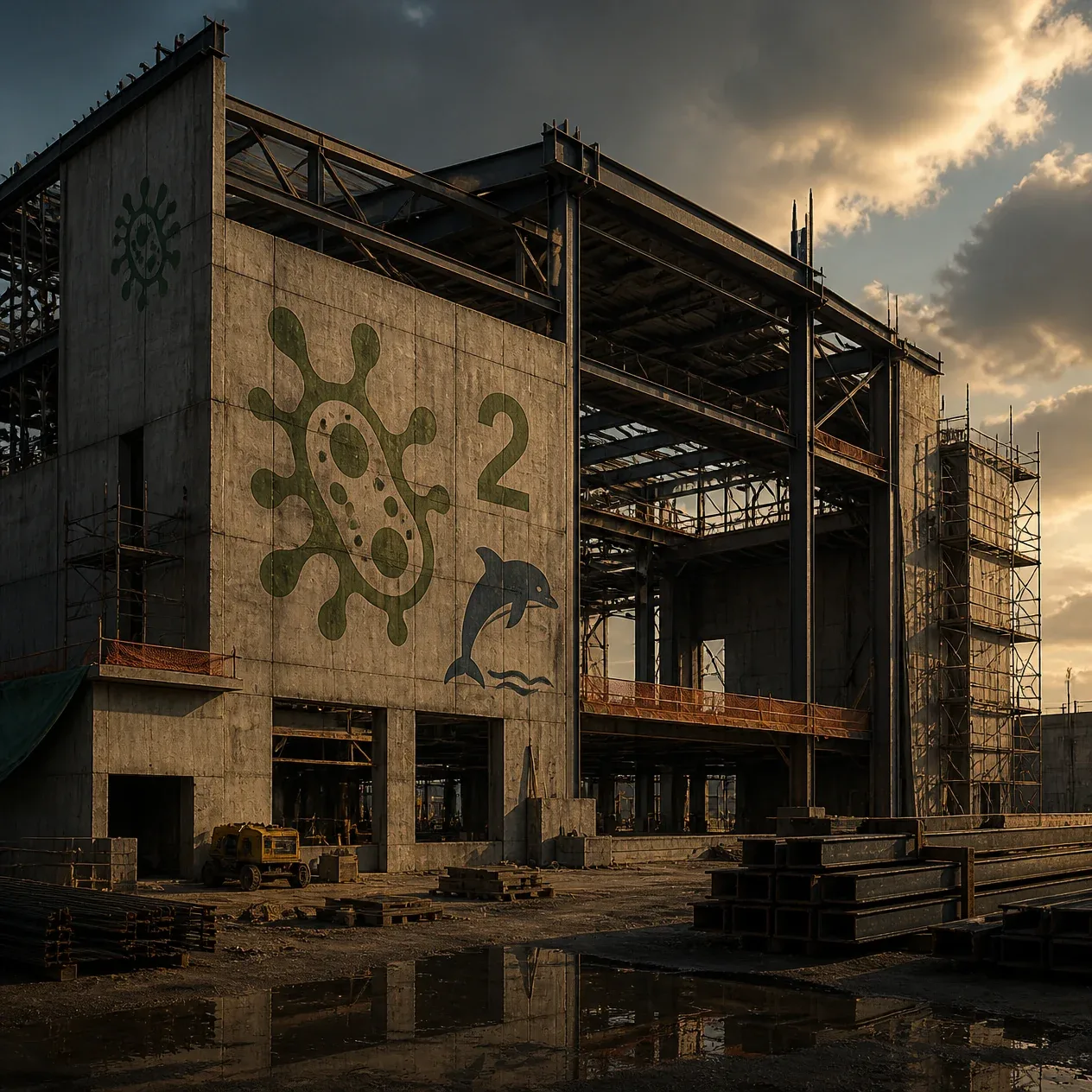
A concrete warehouse under construction at dusk, with an amoeba, the number 2 and a dolphin painted on its wall.
Under construction
What it is

A network of ordinary machines that behaves like a single computer.

Nodes find each other, learn from each other and get faster together. Add a machine and the cluster figures out how to use it.

Code moves to the data

Most distributed systems haul data to code. In Amoebatu, functions are small signed objects that travel to the machine holding the data, the GPU or the database, and send back the result.

Every node is equal

Each machine runs the same stack. There is no master node to lose. Nodes announce themselves over multicast and gossip what they know, so the cluster forms on its own.

The scheduler learns Planned

Every run reports how long it took and where. Over time the cluster learns which work runs best on which machine, and still tries other nodes now and then so it never settles on a false best.

Write code that looks sequential. Amoebatu runs whatever doesn't depend on anything else in parallel.

Lineage · Amoeba OS, 1986–1996

A second try at the computer Amoeba wanted to be.

Andrew Tanenbaum's team at Vrije Universiteit built Amoeba so that a whole network would look like one machine. They got the goal right, and after eight years they wrote down candidly what they got wrong. Amoebatu starts from that list.

“This idea is obvious and we should have realized it earlier and put it in from the start.”

TANENBAUM ET AL., ON MULTICAST · EXPERIENCES WITH THE AMOEBA DISTRIBUTED OS, 1990
AmoebaAmoebatu
FoundationRPC underneath everything, device drivers included, baking synchronous point-to-point assumptions into every layer.
→
FoundationHardware capabilities first, async event channels next. Call-style dispatch is a layer on top, not the base.
MulticastAdded late. Telling many processes something meant N separate calls.
→
MulticastThe first thing built. The discovery daemon finds peers over UDP multicast before anything else runs.
AsyncAsynchronous RPC in version 2.0 proved “impossible to program correctly” and was pulled.
→
AsyncThe language hides it. Code reads synchronously while the runtime dispatches in the background and waits only at real dependencies.
ThreadsNon-preemptable, so adding a debug print could break a critical section.
→
ThreadsPreemptable everywhere from day one, on a modern Linux kernel.
DisplayA homebrew window system that cost years and lost to X.
→
DisplayNo display system at all. The browser is the terminal.
How it works

Layered from the hardware up, not from the network call down.

L4
Adaptive schedulingEmerges from measured performance, not configuration
L3
Function dispatchSigned function objects, Execute and Result messages
L2
Async event channelsCap'n Proto messages and out-of-band cluster events
L1
Hardware capability substrateneighbord: who is on the network and what each node can do

Same stack on every node. Signed with Ed25519, the way you sign a git commit.

Where does a call run?

Always the cheapest place that works, in this order:

inline
free local thread
another node

A remote node is the last resort, and the reason to use one is usually not raw speed:

  • CapabilityIt must move. The call needs a database, GPU, display or feed this node doesn't have.
  • LocalityIt should move. The data lives on another node, so the code goes there and the smaller result comes back.
  • CapacityIt may move. Local cores are busy and the call costs well more than a network round trip.
The Dolphin language

Smaller and smarter than the whales.

Dolphin looks like Python with types at function boundaries. There are no locks, callbacks or async/await. Every call returns a future, and the program waits only where a value is actually used.

ingest.dolno hostnames anywhere
def ingest(paths: dict):
    m = decode_metars(paths["metar"])    # pure: runs near its file
    t = decode_tafs(paths["taf"])        # overlaps with m
    s = decode_sigmets(paths["sigmet"])  # overlaps with m and t
    store(m, t, s)                       # needs a Database: goes to
                                         # the node that has one

def decode_metars(path: str) -> list[Report]:
    lines = read_file(path).decode().split("\n")
    return [decode_metar(r) for r in lines]  # a parallel map,
                                                  # batched for you
metars
tafs
sigmets
store

It works out what each function touches

The compiler reads the whole program first and infers every function's needs. Pure work can run anywhere, be retried and run ahead. Effects keep their order.

pureIODatabaseNetworkLocalOnlyGlobals

Same output at any thread count

Values don't mutate, so there are no data races to chase. A run spread over many threads prints exactly what a single-threaded run prints, and --threads 1 stays a deterministic debug mode.

Hand someone one file

dolphin -c app.dol compiles to a .dcl p-code file that runs with no source. The loader verifies it first and never trusts the file's own claims about what is safe to run in parallel.

Output never blocks

print() drops into a queue and the program keeps going. The same channel will carry a browser UI. Browser UI planned

Use cases

Built against real work from the start.

Every language feature gets proven on a real workload, and every result is checked against an established decoder.

The driving workload

Weather data decoding

GRIB2 model files are hundreds of independent messages with millions of packed values each. METAR bulletins are the opposite: thousands of tiny, uneven reports. Between them they exercise task parallelism, data parallelism and grain size at real scale. Decoded GRIB values are checked against eccodes.

METAR KCOS 262354Z 34012KT 10SM FEW120 M02/M14 A3021
METAR KDEN 262353Z 01009KT 10SM SCT080 M04/M15 A3018
Sample reports. Each line is one cheap, pure decode. The runtime batches them so dispatch never costs more than the work.

Mixed hardware shops

Workstations, GPU boxes and database servers in one pool. A call that needs a GPU goes only to nodes that have one, and a UI call goes to the machine with a display. Capabilities are plain strings your organization defines. Planned

Data services on a server pool

Publish signed source once. Each node compiles and caches it by content hash, and upgrading means publishing new source. Developer PCs can join the same pool. Planned

The idle office

The long-term goal: drop Amoebatu onto an office network and let every PC donate its idle cycles to whatever the cluster is working on. Long term

Beyond weather

The standard library aims broad, with use cases drawn from science, finance, engineering and general data processing. It is the longest-running work on the project. Ongoing

Status and roadmap

Early, and architecturally serious.

The design is written down in detail. The language milestones run on one machine, so they don't wait on cluster hardware. Each milestone must produce the same output as the one before it.

WorkingPartly builtPlanned
  1. M0Parser, interpreter, METAR decoderLexer, parser, needs analyzer and interpreter working, with a real METAR bulletin decoded. Layouts and full typing still to come.
  2. M1GRIB2 simple packing and bitmapsBit extraction, map and scan, matched against eccodes.
  3. M2Implicit futures on a local thread poolBatched parallel map and measured-cost dispatch. Identical output at 1 to 8 threads, clean under ThreadSanitizer.
  4. P2P-code and .dcl filesRegister-based p-code, a standalone file format and a fuzzed verifier.
  5. M3LLVM JIT for numeric codeCompile pure numeric functions on the receiving node.
  6. M4Complex packing and map projectionsSpatial differencing, Lambert and lat/lon grids.
  7. M5Remote dispatch across the clusterCapability-driven placement, signed function objects, then locality and capacity with the adaptive scheduler.
  8. M6–7Look-ahead futures and native codecsDispatch with unresolved values; JPEG2000 and CCSDS through the C interface.

Discovery daemon

neighbord finds peers over UDP multicast and keeps a live peer table.

Cluster membership

Node identity, peer persistence, gossip on discovery and a peer-list API are in progress.

Trust and UI

Trust repository, key management and the web UI are designed, not yet built.

Get involved

Early means your ideas can still shape it.

Read the design document and the Dolphin language reference, then open an issue and say hello.

C++ runtimeScheduler designCap'n Proto messagingSystems and kernel interfacesGossip and consistencyLanguage designStandard libraryEd25519 signing and key managementTesting distributed systems
build itLinux · C++17 · CMake
git clone https://github.com/beneschtech/Amoebatu.git
cd Amoebatu && mkdir build && cd build
cmake .. && make -j$(nproc)